

I'm gonna just say it...
Earlier is better. Almost always. The idea that you need a big portfolio to start is an unfortunate myth.
The common belief goes like this: you spend thirty years accumulating, and once the pile is big enough you hire somebody to manage it. That is a real service, and it works fine. It also skips the entire window where planning changes the number, because the biggest decisions get made long before the pile shows up. And who the heck knows where you could have been?
"I don't have enough money for an advisor yet"
This is the single most common reason people wait, and it is based on a version of the industry that is shrinking.
Plenty of advisors now offer a starter engagement built for exactly this situation: someone earning well, saving something, with a couple of old accounts scattered around and no system holding it together. The earlier you can establish a solid financial system/foundation, the better. It will only get harder as your financial life expands. And the fee you pay will probably dwarf the long-term impact financially and emotionally.
A foundational engagement may look something like this:
- Consolidating the old rollover IRA and the Glossary of Financial ClarityRoth IRANamed after Senator William Roth, who pushed it into law in 1997. The design is clever on both ends: you pay the tax now instead of later, so the government collects its revenue up front, and in exchange your money grows and comes out completely tax-free in retirement. You put in dollars you've already been taxed on, let them grow for years, and qualified withdrawals down the road owe nothing. You're basically betting your tax rate later will be higher than it is today, which is why it tends to shine early in a career or in a low-income year.General education only. Not tax or investment advice. Read the full story into one intentional setup
- Getting idle cash into a high-yield account and naming what it is for, whether that is an emergency reserve or a fund for a career move
- Opening a taxable brokerage account, because retirement accounts alone do not cover a life before age 60.
- A monthly savings system: what goes where, how much, and in what order
- A look at the tax return and an introduction to a Glossary of Financial ClarityCPAA CPA, or certified public accountant, is an accountant who has passed a demanding licensing exam and met state experience requirements. Not everyone who does taxes holds the license, and it lets them do things an unlicensed preparer can't, like represent you in front of the IRS and sign off on audited financial statements.General education only. Not tax or investment advice. Read the full story who will coordinate
- For self-employed income, whether an Glossary of Financial ClarityLLCAn LLC, or limited liability company, is a business structure that puts a legal wall between the company and your personal stuff. If the business gets sued or runs up debt, your house and savings generally aren't on the hook. It's a favorite for freelancers and small business owners because it's lighter to run than a corporation but still gives you that protection.General education only. Not tax or investment advice. Read the full story/S-Corp makes sense and what the path to a Glossary of Financial ClaritySolo 401(k)A Solo 401(k) is a 401(k) built for a business whose only workers are the owner and maybe a spouse. Because you're both the boss and the employee, you get to contribute from both sides, which lets you set aside far more than a regular IRA allows. It's a go-to for freelancers and one-person businesses with strong income.General education only. Not tax or investment advice. Read the full story with maximum tax deferability
- Review estate plan and beneficiaries
At the end of the day, the goal is to graduate you out of it. The reality is the work changes as your balance sheet grows. There are levels to this.
Remember that a decade of Glossary of Financial ClarityCompoundingYour money earns money. Then that money earns money too. (Yes, read that twice, that's the whole trick.) It feels painfully slow at first, and then the snowball gets big enough that the growth dwarfs whatever you actually put in. Time is the one ingredient you can't add later.General education only. Not tax or investment advice. Read the full story on a decent system beats a great system started at 45. How to Choose a Financial Advisor
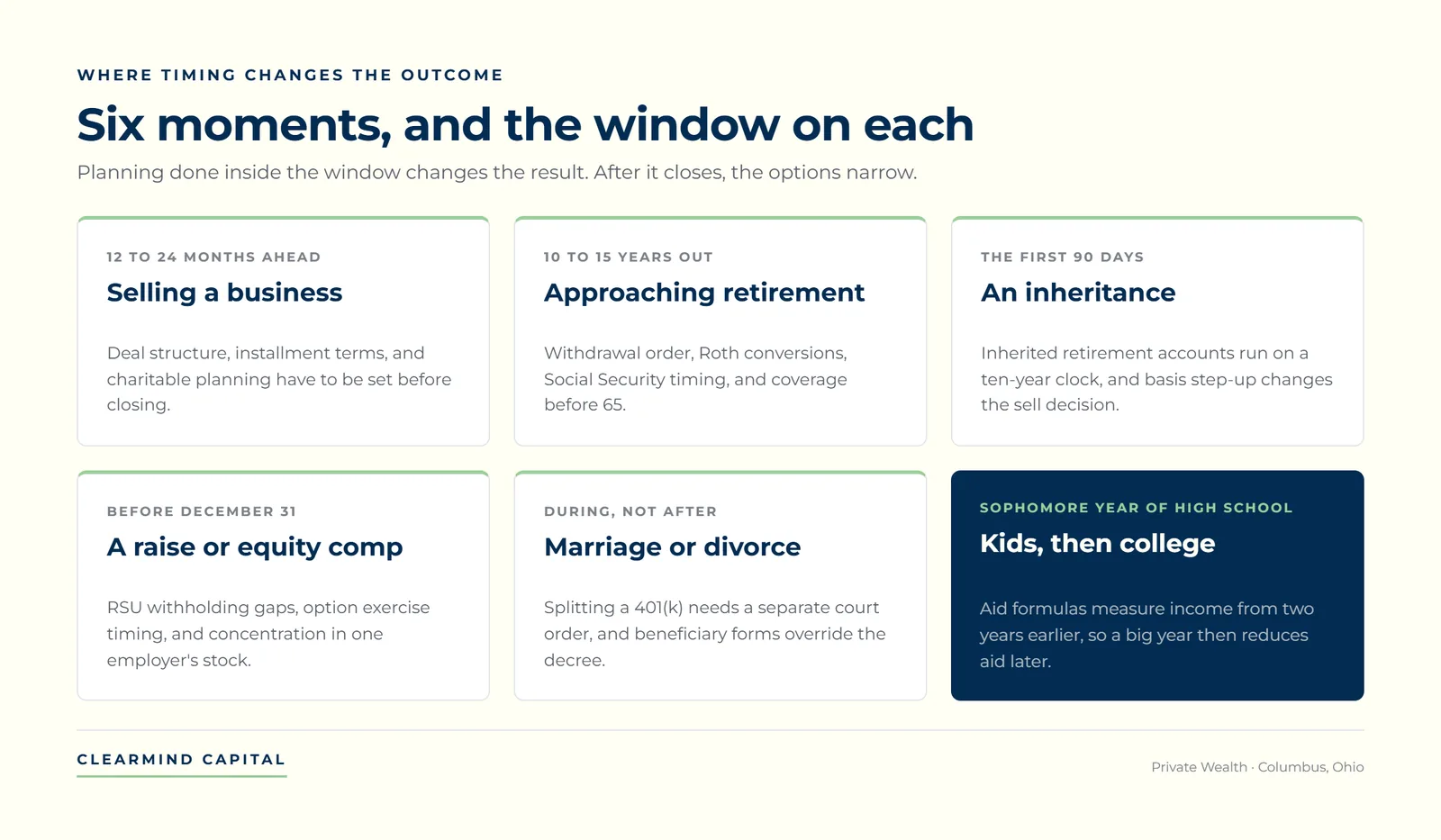
Six moments where timing decides the outcome
Beyond getting organized, these are the transitions where waiting may cost you some money.
1. You are selling a business
A liquidity event compresses a decade of tax decisions into a few months, and nearly all of the planning that helps has to happen before the deal closes.
Sell for $2 million with no preparation and you might recognize the entire gain in one year, land in the top Glossary of Financial ClarityCapital gainsThe profit when you sell something for more than you paid. Hold it longer than a year and it's “long-term,” which gets taxed at friendlier rates. Sell inside a year and it's “short-term,” taxed like your paycheck.General education only. Not tax or investment advice. See the full glossary bracket, pick up the 3.8% net investment income tax, and end up with a lump sum and no structure behind it.
With lead time the levers to plan around may be: whether the deal is structured as an asset or stock sale, whether installment terms spread the income across tax years, how purchase price gets allocated, qualified small business stock treatment if your entity qualifies, and funding a charitable vehicle with appreciated equity before the sale rather than writing checks after it. Some of those need months. A few need years.
Columbus has a deep bench of closely held businesses, so this conversation comes up here often.
2. You are ten to fifteen years from retiring
This window is crucial.
What gets decided here: which accounts you draw from and in what order, how much to convert to Roth in the low-income years between your last paycheck and your first required distribution, when to claim Social Security relative to everything else, how to cover health insurance in the gap before Medicare at 65, and how much of a bad first two years your plan can survive.
These interact in ways that are hard to hold in your head at once. Roth conversions raise this year's income, which raises Medicare premiums two years later through a surcharge called IRMAA, which shrinks how much you can convert next year.
This window is also crucial if you are feeling angst about progress. We have helped families and individuals make up a lot of ground in these years. Life-changing ground... but you have to be committed. And in full transparency, a long bull market certainly helped.
3. Money showed up that you did not earn this year
An inheritance, a settlement, a life insurance payout. The practical question is what to do with it, and the default is to park it in cash while you think, which has a way of becoming a two-year decision. Time certainly does fly.
Inherited retirement accounts carry rules that changed somewhat recently depending on when you're reading this. Beneficiaries other than a spouse generally have to empty an inherited IRA within ten years, and if the original owner had already started required distributions, annual withdrawals are required during that window too. Getting the schedule wrong costs tax efficiency you cannot recover. Inherited taxable accounts usually get a step-up in basis, which makes the sell-or-hold question look completely different from what people assume.
4. Your income jumped, or equity compensation started
Going from $130,000 to $280,000 changes the arithmetic on decisions you thought were settled. Deductible IRA contributions phase out. Backdoor Roth becomes relevant, and a large pre-tax IRA balance complicates it. Tax-loss harvesting starts to matter. Municipal bonds enter the conversation.
Equity compensation brings its own mechanics. RSUs are taxed as ordinary income when they vest, and the standard 22% supplemental withholding rate routinely underwithholds a high earner, which shows up as an unpleasant April. Incentive stock options can trigger alternative minimum tax on exercise without producing any cash to pay it. An ESPP has a holding period that decides whether your discount is taxed as ordinary income or capital gain.
Should I keep going..?
Because then there is concentration. Holding a third of your net worth in your employer's stock feels like conviction while it is up. It is one company holding both your salary and your savings.
Nearly all of this has a December deadline. This one is a heavier conversation and needs to be handled with care. (not kidding)
5. You got married, or you are getting divorced
Both reset the whole picture: accounts, beneficiaries, filing status, insurance, estate documents. Phew...
Marriage raises questions that sometimes are never asked. How you hold accounts. Whether filing jointly or separately produces a better result, which is genuinely not obvious when both people earn well or one is on an income-driven student loan plan. Whether you are building toward the same thing on the same timeline. The goal here is to talk. It's easy to avoid and push off... so find someone who can help if that's the case.
Divorce is, of course, a different ball game. Splitting a 401(k) or pension requires a separate legal document called a QDRO, and it does not happen automatically with the decree. IRAs divide through a different mechanism. Beneficiary designations override your will, so an ex-spouse still named on a 401(k) inherits it regardless of what the decree says. The situation stinks and it's not fun... I have a high amount of empathy for those that go through this.
6. You had kids, or they are nearing college
At birth, the list is short and consequential: term life insurance sized to the actual obligation, a will naming a guardian, beneficiary designations updated, and a 529 opened early enough for compounding to matter. Ohio's plan offers a state income tax deduction for contributions. It's not the sexiest deduction in the world, but it helps.
As college approaches, it gets more technical. Financial aid formulas weigh parent income far more heavily than parent assets, and they look at income from two years prior. That means the tax year when your kid is a high school sophomore is the one being measured. A business sale, a large Roth conversion, or an option exercise in that year can cost you aid, and families find this out afterward with some regularity. There's also the question we get a lot...
"How much should we be saving for our kids vs. our retirement?"
And it's a good question. Happy to answer that with you sometime.
The ages that matter
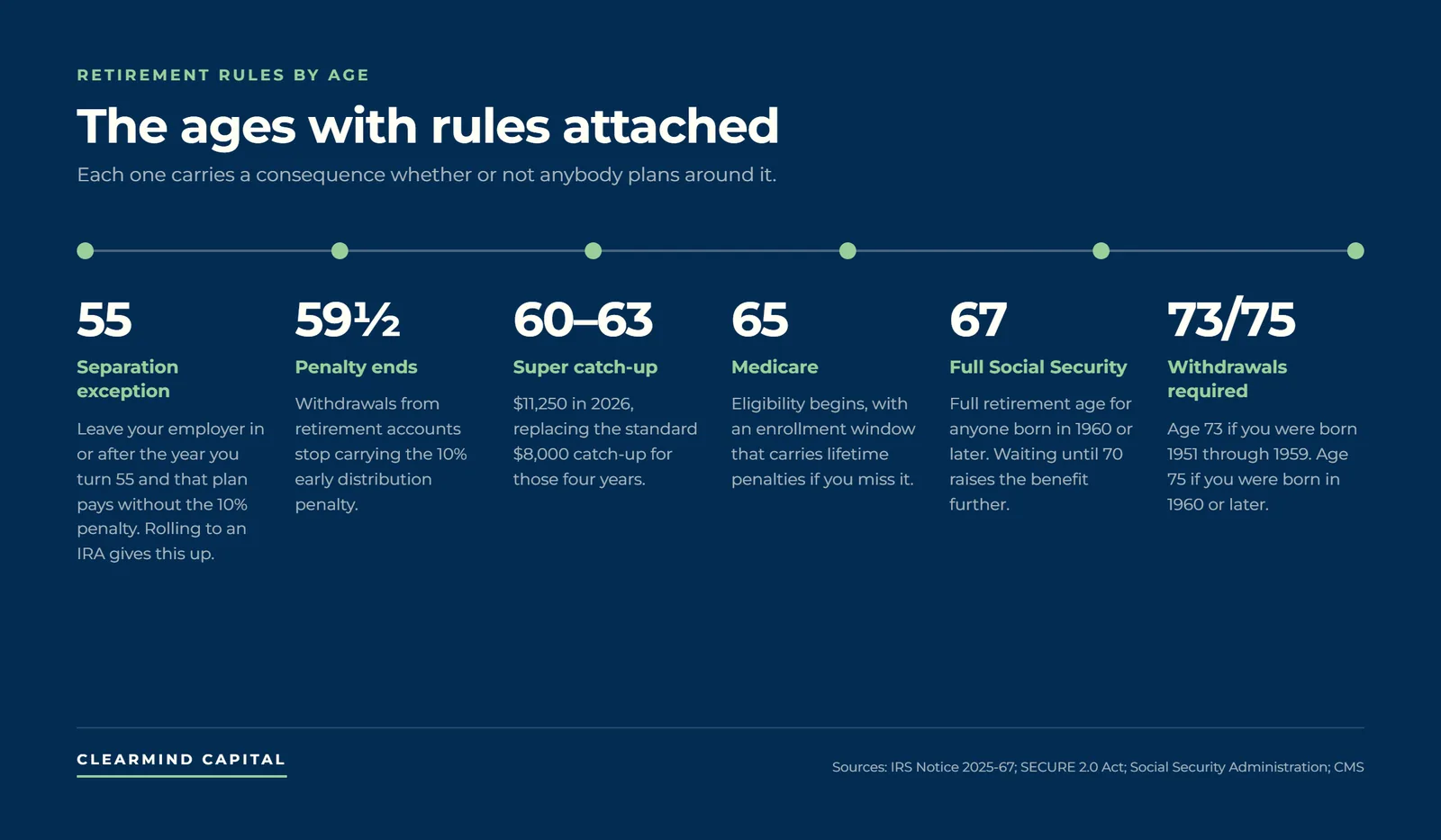
Age 55. Leave your employer in or after the year you turn 55 and you can take money from that employer's plan without the 10% early withdrawal penalty. Roll it to an IRA first and you lose this.
Age 59½. Withdrawals from retirement accounts stop carrying the 10% penalty.
Ages 60 to 63. The super catch-up applies, $11,250 in 2026, replacing the standard $8,000 catch-up for those years.
Age 65. Medicare eligibility, with an enrollment window that carries lifetime penalties if you miss it.
Age 67. Full Social Security retirement age for anyone born in 1960 or later. Waiting until 70 increases the benefit further.
Age 73 or 75. Required minimum distributions begin at 73 if you were born 1951 through 1959, and at 75 if you were born in 1960 or later.
Common questions
How much money do you need to hire a financial advisor?
There is no universal minimum. Advisors who charge a percentage of assets often set account minimums, but many also offer foundational or starter engagements priced as a flat annual fee. Hourly advice is another entry point but definitely less common. Most advisors offer a no-cost introductory meeting to learn about their process.
When should I start working with a financial advisor?
The earlier you can establish a financial system that works for you, the better. Some seek and invest in a financial advisor to partner with; others may try to do it on their own. Some notable moments may be: a business sale, being ten to fifteen years from retirement, an inheritance, a significant income increase or new equity compensation, marriage or divorce, and having children or approaching college.
Should I talk to a financial advisor before selling my business?
Yes, and ideally twelve to twenty-four months before closing. Deal structure, installment terms, purchase price allocation, qualified small business stock treatment, and charitable strategies all have to be arranged before the transaction. Most of those options close once the sale is done.
At what age do required minimum distributions start?
Age 73 for people born between 1951 and 1959, and age 75 for people born in 1960 or later, under the SECURE 2.0 Act.
What is the rule of 55?
If you leave your employer during or after the calendar year you turn 55, you can withdraw from that employer's retirement plan without the 10% early distribution penalty. The exception applies only to that plan, and rolling the money into an IRA forfeits it.
 Written byNick GeorgeCFP®, ChFC®, CLU®, IWA™FounderView bio →
- IRS Notice 2025-67: 2026 retirement plan limits, including the age 60 to 63 catch-up amount.
- SECURE Act of 2019, section 401 (ten-year rule for most non-spouse beneficiaries); SECURE 2.0 Act of 2022, sections 107 and 126.
- Social Security Administration: full retirement age by year of birth. Centers for Medicare and Medicaid Services: initial enrollment period and late enrollment penalties.
- IRS Publication 575 and Topic No. 558: early distribution penalty and the age 55 separation from service exception.
- FAFSA Simplification Act: prior-prior year income basis for federal financial aid. Ohio Revised Code 5747.70: state deduction for Ohio 529 contributions.
The information presented in this article is for informational purposes and should not be intended as tax, accounting or legal advice, nor is it an offer or solicitation to buy or sell, or as an endorsement of any company, security, fund, or other offering. Please consult your legal, tax, or accounting professional regarding your specific situation. Investments involve risk and have the potential for complete loss. It should not be assumed that any recommendations made will necessarily be profitable.
The opinions expressed in any commentary posted on this site are solely those of the individual author and do not necessarily reflect the views or opinions of ClearMind Capital, LLC. These opinions are based on information available at the time of posting and are subject to change without notice. ClearMind Capital, LLC, does not commit to updating any posted positions or commentary to reflect subsequent developments. While the information and reasoning used to form these opinions are believed to be from reliable sources, ClearMind Capital, LLC, does not verify this information, and no guarantee is provided regarding its accuracy, completeness, or validity. ClearMind Capital, LLC, disclaims any and all liability for actions taken or not taken based on the content of this site. No warranty, express or implied, is given in connection with the content provided.
Certified Financial Planner Board of Standards Center for Financial Planning, Inc. owns and licenses the certification marks CFP®, CERTIFIED FINANCIAL PLANNER®, and CFP® (with plaque design) in the United States to Certified Financial Planner Board of Standards, Inc., which authorizes individuals who successfully complete the organization’s initial and ongoing certification requirements to use the certification marks.


