

Ask a business owner who is responsible for their company Glossary of Financial Clarity401(k)A retirement account through your job where money leaves your paycheck before you ever see it. If your employer matches, that match is about the closest thing to free money you'll get offered at work. It comes in traditional (tax later) and Roth (tax now) flavors.General education only. Not tax or investment advice. Read the full story. You'll usually get a company name back. Sometimes the first name of a rep there.
Neither one is the answer.
This isn't a paperwork problem. Your plan is probably running fine. Money goes in, statements go out, the filing gets made every summer. The gap only shows up when you ask who is watching the plan as one thing instead of five.
Nobody can tell me what a retirement plan advisor does
I ask this a lot. Owners, controllers, office managers who have run payroll for twenty years. What comes back is a shrug, or "they picked the funds," or "someone came in and did an enrollment meeting once."
Fair enough. The title doesn't explain itself, and nobody hands you a job description when you start a plan.
It's easier to see from the work than from the title.
The work your 401(k) needs every year
Forget the org chart for a minute and look at what a plan needs someone to do, year after year.
Someone has to watch the investment menu against standards written down ahead of time. The default fund, where employees land when they don't pick anything themselves, deserves more attention than the rest of the menu.
The fees need checking against what other plans your size are paying. Reasonable is a comparison. There's no set number that makes a fee fine on its own.
Then there's the design. Eligibility rules and the match formula were probably set the year you started the plan and haven't been touched since.
Compliance dates have to be hit. And your employees need more than one meeting during onboarding.
Now put a company name next to each of those.
Your recordkeeper runs the plumbing. Your administrator does the testing and the filing. The custodian holds the money. The auditor looks back once a year to check that the numbers were right.
Each one is doing the job you hired them for. None of those jobs covers the other four.

The job that never got assigned
There's a difference between a plan where every task has an owner and a plan where someone is accountable for the whole thing.
That second one is a separate seat. On a lot of small and mid-sized plans, it's empty.
The person in that seat watches the whole field. They keep the providers in sync, so the payroll file and the plan document and the investment menu all say the same thing. They write down how decisions got made. They run a calendar, so reviews happen on schedule instead of when somebody finally asks.
That's a plan advisor. Picking funds is one piece of it.
Where the responsibility goes when that seat is empty
ERISA assumes somebody is watching the plan. It doesn't say who.
The Department of Labor puts it this way in its guide for employers: "Glossary of Financial ClarityFiduciarySomeone legally required to put your interests ahead of their own paycheck. Sounds like the bare minimum, and yet a lot of the financial world doesn't work that way. When an advisor is a fiduciary, “is this good for me or good for them” has a clearer answer.General education only. Not tax or investment advice. Read the full story status is based on the functions performed for the plan, not just a person's title." A fiduciary is someone legally required to act in the employees' interest. If you have real say over the plan or the money in it, you're one, for the part you have say over.
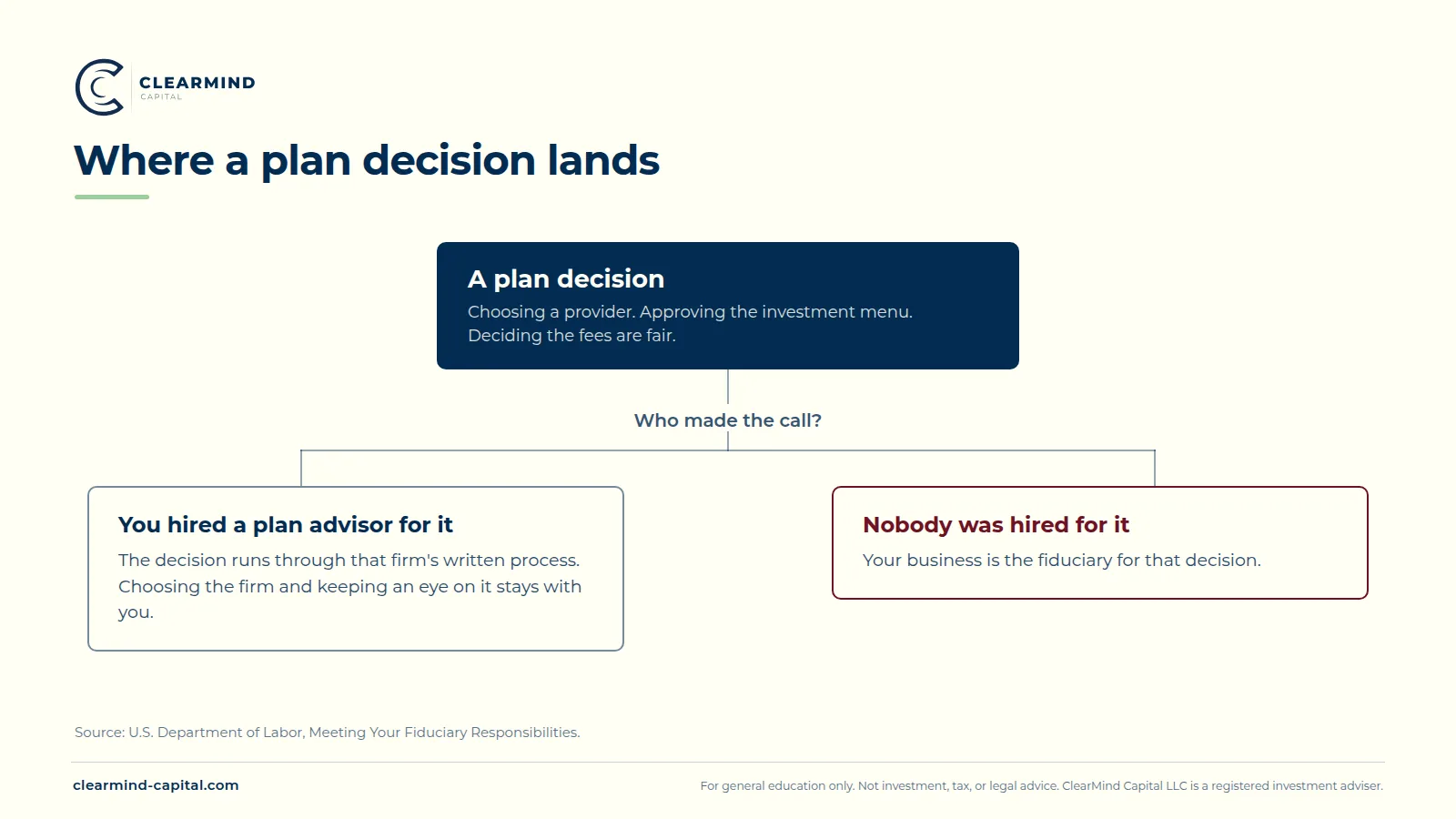
Read that again with your own plan in mind. If you're the one who approves the provider, signs off on the menu, and decides the fees look fine, you're already in that role.
The same guide says something else worth knowing: "Hiring a service provider in and of itself is a fiduciary function." Picking your recordkeeper was your decision to answer for, and the DOL expects you to look at that choice again on a regular schedule.
None of this means your plan is in trouble. The work has an owner either way. If you never hired it out, that owner is your business.
What changes once somebody is in the seat
Less than you'd expect, from the outside. A calendar. A written standard for the menu. A fee comparison on a schedule instead of whenever a competitor sends over a proposal. Notes that show how a decision got made, written at the time it got made.
What owners notice is that the questions stop showing up as surprises.
Next in this series we'll go provider by provider, because "my recordkeeper handles that" is the sentence that starts most of these conversations.
Common questions
Who is the fiduciary on a small company 401(k)?
Your plan document has to name at least one, and for a small business that's usually the company or an officer of it. Past that, ERISA treats anyone with real say over the plan or its money as a fiduciary, for the part they have say over. Your title doesn't decide it.
Isn't our recordkeeper handling all of this?
A recordkeeper tracks accounts, processes transactions and runs the employee website. That list is spelled out in your service agreement, and it doesn't include deciding whether the menu is any good, whether the fees are fair, or whether the design still fits your payroll. Those decisions stay with the plan's fiduciaries.
Our CPA reviews the plan once a year. Does that cover it?
An accountant reviewing the plan, or running the audit once your plan is big enough to need one, is checking backward that things were recorded correctly. That work matters, and it's a different job from watching the menu, the fees and the design through the year.
Nothing has gone wrong with our plan. Does this still matter?
ERISA looks at how you decided, not how it turned out. The question is whether somebody who knew what they were doing, being careful, would have done the same, and whether you can show it. A plan can run clean for years and still have nothing on paper about how its decisions got made.
What does a 401(k) plan advisor do?
Watches the investment menu against written standards, compares your costs to similar plans, reviews the design before each plan year, keeps a record of the review cycle, and runs employee education on a schedule. What sets the job apart is the scope. An advisor is responsible for the whole plan instead of one piece of it.
Can we hand the responsibility off entirely?
Part of it. Responsibility moves when discretion moves. Bring in a firm that takes discretion over the investment menu and that firm answers for those decisions. An arrangement where somebody only recommends and you approve leaves the decision sitting with you. What never transfers is choosing that firm in the first place and keeping an eye on it afterward.

 Written byAustin Wolfe & Joe AndersonClearMind Capital · Workplace RetirementView bio →
- U.S. Department of Labor, Employee Benefits Security Administration, Meeting Your Fiduciary Responsibilities (September 2021), on fiduciary status by function, the named fiduciary requirement, hiring a service provider as a fiduciary act, and documenting decisions.
- ERISA section 404(a)(1), 29 U.S.C. 1104, the duties of loyalty, prudence, diversification, and following the plan document.
- ERISA section 3(21)(A) and section 3(38), 29 U.S.C. 1002, defining a fiduciary by function and an investment manager.
- 29 CFR 2550.408b-2, requiring service providers to tell the responsible plan fiduciary what they do and what they are paid.
The information presented in this article is for informational purposes and should not be intended as tax, accounting or legal advice, nor is it an offer or solicitation to buy or sell, or as an endorsement of any company, security, fund, or other offering. Please consult your legal, tax, or accounting professional regarding your specific situation. Investments involve risk and have the potential for complete loss. It should not be assumed that any recommendations made will necessarily be profitable.
The opinions expressed in any commentary posted on this site are solely those of the individual author and do not necessarily reflect the views or opinions of ClearMind Capital, LLC. These opinions are based on information available at the time of posting and are subject to change without notice. ClearMind Capital, LLC, does not commit to updating any posted positions or commentary to reflect subsequent developments. While the information and reasoning used to form these opinions are believed to be from reliable sources, ClearMind Capital, LLC, does not verify this information, and no guarantee is provided regarding its accuracy, completeness, or validity. ClearMind Capital, LLC, disclaims any and all liability for actions taken or not taken based on the content of this site. No warranty, express or implied, is given in connection with the content provided.
Certified Financial Planner Board of Standards Center for Financial Planning, Inc. owns and licenses the certification marks CFP®, CERTIFIED FINANCIAL PLANNER®, and CFP® (with plaque design) in the United States to Certified Financial Planner Board of Standards, Inc., which authorizes individuals who successfully complete the organization’s initial and ongoing certification requirements to use the certification marks.


